Contact Patch Politics: Choosing Tyres for a British MV Agusta
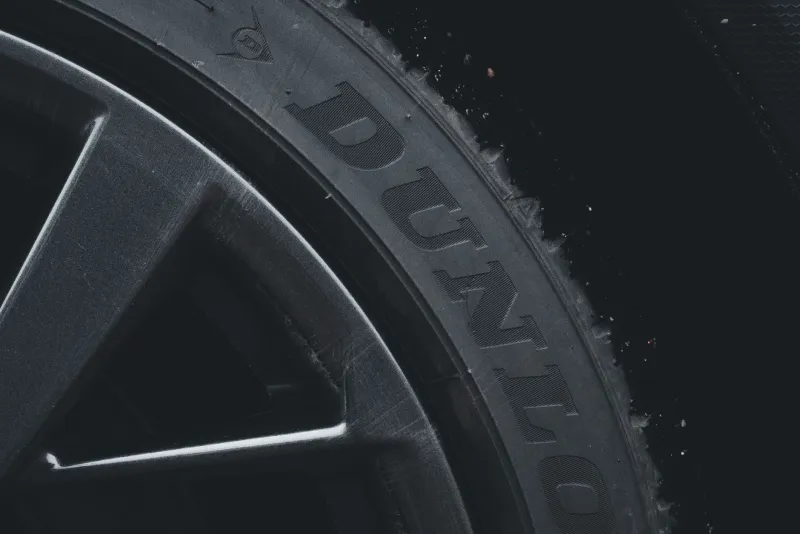
Every ride you take on an MV Agusta comes down to a pair of hand-sized contact patches. Nothing else — not the trellis frame, not the counter-rotating crank, not the exhaust note bouncing off a dry-stone wall — actually touches the road. And in Britain those patches are asked to work in conditions that flatter almost nothing: coarse surface dressing, tar snakes, standing water in the wheel tracks, salt residue in February and ambient temperatures that rarely help a performance compound do its job.
So tyre choice on a Brutale or an F3 is not a footnote to ownership. It is the single biggest variable in how the bike feels, how safe it feels and how much it costs to run. This is the ownership conversation, not the spec sheet.
Britain Is the Test Rig
Start with the surface, because it is not the one the tyre was designed on. Much of the UK's B-road network is chip seal or surface dressing — a coarse, abrasive, occasionally loose aggregate sprayed over bitumen. It can be grippy in the dry and treacherous when a fresh dressing has not bedded in. Add the seasonal layer: diesel at roundabouts, agricultural mud on the inside of bends, leaf mulch in October, and the damp that lingers under trees long after the sun has cleared the open road.
Crucially, our roads rarely let a tyre reach its designed operating window. A fast hypersport tyre wants 60–80°C of surface temperature to give its best. A brisk hour on a damp A-road in April might get you halfway there. That gap between design and reality is where the wrong choice becomes obvious.
What the Bike Actually Asks of the Tyre
MV Agustas are not gentle on rubber. The three-cylinder and four-cylinder engines deliver torque early and hard, the chassis is stiff, the geometry is quick to steer and the rear tyre is expected to hold shape under drive from the apex out. On the F3 the front carries real load under braking thanks to the radial calipers and stiff forks, and the Brutale's upright bars put more weight through the rear than a clip-on machine.
The consequence is a tyre that must warm quickly, resist squaring under acceleration and still offer feel from cold — a much broader brief than pure lap times.
Hypersport or Sport-Touring: An Honest Split
Hypersport rubber — Pirelli Diablo Rosso IV Corsa, Supercorsa SP, Metzeler Racetec RR, the sharper end of Michelin's Power range — offers wonderful steering precision and immense grip once hot. The trade-offs are real: a narrower temperature window, less confidence in the wet, faster wear and a higher price. If you ride trackdays, if your Sunday mornings are dry and committed, or if you genuinely get heat into a tyre on a favourite road, they earn their keep.
Sport-touring and sport-touring-adjacent tyres — Pirelli Angel GT II, Michelin Road 6, Continental RoadAttack 4, Dunlop Roadsmart IV, Metzeler Roadtec 02 — use silica-rich compounds that come up to temperature quickly and stay there. They are markedly better in the cold and wet, they resist squaring on motorway slogs and they last. The penalty is a little steering speed and a little ultimate edge grip when you are really pressing on.
For most British riders, on most British days, the sport-touring or sport-tourer-derived option is the faster real-world tyre. It is not the fashionable answer, but it is the honest one. The rider who fits Supercorsas and then commutes 60 miles a day in November is buying a beautiful liability.
Warm-Up and Pressure Discipline
Pressure is where more MV owners get it wrong than anywhere else. Check cold, before you ride, with a decent gauge — not the one on the garage forecourt that has been dropped forty times. Use the manufacturer's road figures, then adjust for load: a pillion and luggage on a touring weekend want a few more psi in the rear, not a track-day setting.
Cool mornings matter. A tyre set to 36 psi in a 6°C garage will gain less pressure as it warms than the same tyre set on a 25°C afternoon in July, so do not chase a 'hot' target on the road. And resist the urge to drop pressures for 'feel' — on a heavy, torque-rich bike, low pressure means a squirming carcass and a hot, overheated tyre that gives up early.
Warm-up is a discipline, not a rumour. Ten to fifteen miles of progressive lean angle, gentle braking and smooth throttle will do more for grip than any additive or internet theory. No tyre warmers on the road. And treat TPMS as a helpful hint, not a calibrated instrument — cross-check it monthly.
Reading the Road, Not Just the Tread
Good tyre management is mostly observation. Assume the shaded patch under a bridge is wet when the rest of the road is dry. Assume the roundabout has a diesel stripe. Assume the newly dressed surface has loose chippings on the racing line for a fortnight. On a bike with the throttle response of an MV, a moment of restraint in these places is worth more than a compound upgrade.
When Is a Tyre Genuinely Finished?
Tread depth is only one measure. Wear bars are the legal minimum, but a tyre can be well above them and still done. Squaring — a flattened centre section from straight-line miles — ruins the profile and makes the bike fall into turns; the tread may look fine. Cupping on the front, usually from heavy braking and under-inflation, spoils feel long before the wear bars appear.
Heat cycles harden a compound even when tread remains. Age counts too: check the DOT date code on the sidewall, and treat anything past five or six years as suspect regardless of mileage. Cracks in the sidewall grooves, a puncture close to the shoulder, or a tyre that has run a long distance at very low pressure are all reasons to replace rather than persevere. On a bike that rewards grip as much as this one, 'a bit more life' is a false economy.
Wear Rates and What It Really Costs
An enthusiastic rider on hypersport rubber can expect 2,000–3,500 miles from a rear; a sport-touring rear will typically stretch to 4,000–6,000. Fronts usually last around twice as long on touring-biased rubber, and closer to one-to-one on sticky compounds. Fitted prices in 2026 sit roughly at £180–£300 for a rear and £140–£230 for a front, so a pair lands somewhere between £330 and £500 depending on brand, size and who fits it.
If you cover 5,000 miles a year, budget for two rears and a front — more if you do trackdays. That is the realistic ledger, and it is worth building into the cost of ownership rather than discovering in a tyre bay on a Saturday morning.
Match the Rubber to the Riding You Actually Do
Be honest about your riding, not the riding you imagine. A commuter who does two trackdays a year needs a sport-touring tyre and a spare set of wheels, not a single set of race-compound rubber that is cold for 90% of its life. A fair-weather Sunday rider on fast A-roads will be delighted by a sporty sport-touring tyre and will never miss the last few per cent. A dedicated track rider should have a separate set and treat road rubber as a different tool entirely.
The MV deserves a tyre chosen with the same care as its oil and its chain. Get the compound right, hold the pressures, read the road and replace without sentiment — and the bike will give you exactly what you bought it for.